Showing posts with label 333SP13. Show all posts

Wednesday, May 1, 2013

Little White Schoolhouse

The Little White Schoolhouse is located in Valley, WA. The Valley community wanted to turn this Schoolhouse into a historical museum. To bring a sense of togetherness within the two communities and the historical essence of the Valley, as well as attracting tourist attention, Tamara Upton,  Emily Van Dyke and I came up with the theme, "Uniting the past and future." In order to bring different generations together, we focused on making the space rustic and modern.
 
I researched a case study on the Scottish Rite Masonic Museum & Library Inc. in Lexington, MA. This research was intended to help me understand more about what a heritage museum is all about.


Here are the final posters of The Little White Schoolhouse design.
(Posters by: Nkojoua)


Here are the perspectives I designed through SketchUp, Kerkythea, & Photoshop.  

 
Reception area

Industries Exhibit
 
Memories of Valley in motion & Family History

Lower Level Entrance

Mock Up of a kitchen in 1900's
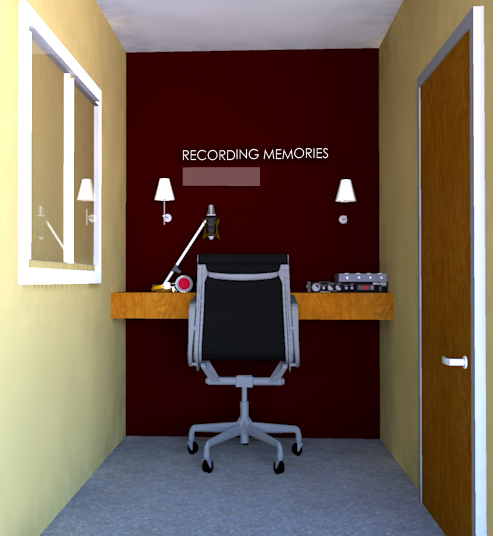
Room for recording and listening to stories
 

This project was a great learning experience. My classmates and I had the opportunity to visit Valley, WA to meet the Valley community. We had a discussion about what they valued and wanted for the Schoolhouse. What I've learned from this real life experience was seeing how much the Little White Schoolhouse means to them regardless of the small size of their town.

I feel that our design was successful because we kept the historical essence and structure of the building. We added a some walls and lighting fixtures to give it a more modern look and feel, at the same time focusing on the history.

Wednesday, February 20, 2013

Webster Hall

The Webster Hall on WSU campus, Pullman, WA has an exhibit that no one hardly stops to take a look at it. My team and I wanted to improve and enhance the experience of the exhibit for everyone. Our focus was to engage the visitors through interactive and hands on activities, along with adding colors and fun fonts to attract attention.
 
PHASE ONE: My team observed the circulation paths by the students, staffs and visitors in Webster Hall. We found out that many people just go in and out of the building without stopping to take a look at the museum.  
 
FLOOR PLAN: We moved a few of the existing interactive and plants around. Benches were added to allow more seating for visitors.
 
CASE MOCK UPS: We researched information about the Big Bang, the Rock Cycle, the Water Cycle, Land and Sea, Environmental Hazards, Palouse Geology, and the WSU Specialties. We measured the cases in Webster Hall and designed posters to cover each case. While my team members did the research, I designed the mock up posters. The fun fonts and colors create a fun learning environment.
 

Posters by: Emily Van Dyke
 
PHASE TWO: We recreated labels for the existing physics interactive by reducing the instructions and changing the color and graphics to the same style as the case mock ups. We also added more engagement activities.
 

Poster By: Emily Van Dyke
 
This project was a challenge for working with a big team of nine people. I feel that we did a great job as a team because everything turned out well.
 
Mock Ups by: Nkojoua Yang
 
Here is a preview of the case mock ups I designed. Each poster was 4'x7'. I learned a lot about graphic designing in this project. One of the most important things I learned was to divide up writing portions into columns so that the reader could read easily without getting lost. The images  and information were given to me by my team members so some of the graphics are not that clear. The most challenging part during the process of putting the posters together were the negative space. I couldn't fill up most of the page because it would be too hard to read if the font sizes were too big and the graphics would become blurry. Overall, this project was a success.


Case Studies

 
The objective of this project was to research three case studies of informal learning environments. These case studies had to include informal learning typology, organizational philosophy, educational intent, graphic identity and marketing, interpretive graphics, topical intent, interactive and children/family-focus.
 
For the three posters of the museums, I identified who, what, where, why and when. The fourth poster focused on researching the effect of color on users, personality typologies and ergonomics.
 
The layouts are organized to help make it easy to read and understand. I used a similar layout and design to create unity for all the posters.
 
I am satisfied with the layout organization and fonts that I chose and feel that I have completed this small project successfully.